
After 9 Years in KRG
Nine years ago, we arrived in Arbat Refugee Camp in the Kurdistan Region of Iraq carrying a belief that felt both obvious and, in the humanitarian sector, quietly radical: that young people who had survived displacement, conflict, and the particular kind of erasure that comes with being forgotten by the world deserved more than programming designed simply to keep them stable. They deserved to be prepared for what came next, whatever that turned out to be.
In December 2025, we closed that site. And I find myself wanting to write about that in a way that holds the full complexity of what it means — not the press release version, not the pivot narrative, but something closer to the actual texture of a decision that was both right and painful.
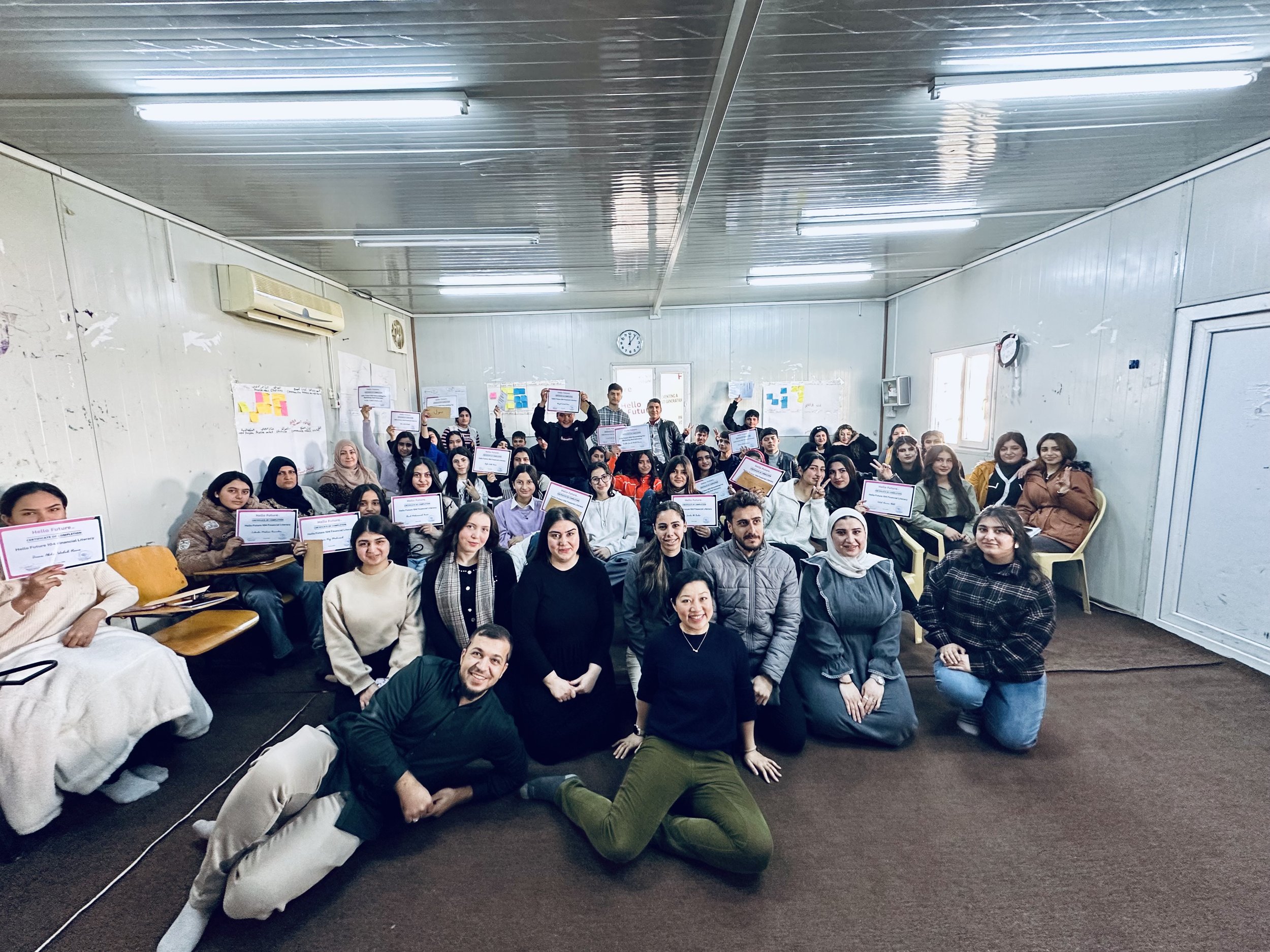
Hello Future Classroom, Arbat Refugee Camp, Feb 2025
What We're Carrying
There were layoffs — people who had given years of their lives to this work, who had built something genuinely rare in a refugee camp, and who deserved more continuity than the funding landscape allowed us to provide. There were students and families who had woven Hello Future into the rhythm of their days, for whom our presence had come to mean something beyond programming, and who experienced our departure as another in a long series of abandonments that displacement tends to accumulate.
We wanted to stay. It feels important to say that plainly, because the strategic framing that follows is true but incomplete without it. Funding realities foreclosed options we had genuinely hoped to keep open, and the decision to leave was made in full awareness of what it would cost a community we cared for deeply. Honesty about that matters more than a clean narrative about strategic foresight.
What I can say, with equal honesty, is that the work we did in Arbat was real, and that it matters in ways that outlast our physical presence there.
What We Built There Was Always Meant to Travel
When young people are displaced, what they lose is not only their homes, schools, or immediate communities, but something harder to name and harder to recover: the sense of continuity that tells you who you are in relation to the world, the accumulation of small confirmations that your future is real and worth investing in.
Displacement that lasts, on average, twenty years, doesn't merely interrupt development. It reshapes the interior architecture of a young person's relationship to possibility, agency, and trust in systems that are supposed to work on their behalf. That reality shaped everything we chose to teach and how we chose to teach it — not skills as ends in themselves, but the deeper capacities underneath them: the confidence to set an agenda for your own life, the judgment to navigate situations no training could fully anticipate, and the sense of oneself as a capable and purposeful actor in a world that has not always agreed.
Over nine years in KRG, and through partners globally, that approach reached 4,000 students, delivered 150 courses, maintained a 98% retention rate, and saw young people entering higher education at two and a half times the global average. Yet the work was never meant to remain in one place.
As we moved deeper into partnership work, something became clear. The framework we had developed was not only relevant for displaced youth. The developmental gap we were addressing — the gap between systems that teach skills and systems that build the human foundation those skills require — belongs to a far broader population. Underserved young people everywhere are navigating institutions that train them for tasks without strengthening the interior capacities required to navigate an uncertain world.
The model was always meant to travel. We simply did not yet understand how far.
What the Sector Collapse Clarified
The dismantling of U.S. foreign aid has shaken the humanitarian sector in ways that are still unfolding. While Hello Future was never a direct recipient of that funding, the organizations we work alongside and care about have been affected in immediate and devastating ways. In the aftermath of January’s stop-work orders, we watched three NGOs pull up stakes in Arbat practically overnight, leaving gaps in a community of 10,000 people that will not be filled quickly or easily.
We had hoped to stay, but the confluence of sector-wide pressure and our own funding constraints made that impossible. Honesty about that matters more than a clean narrative about strategic foresight.
What this rupture has made visible is a set of contradictions the sector has carried for a long time without fully reckoning with. Foreign assistance, for all the genuine good it has done, often builds systems whose operational ownership is local while their financial lifelines remain external. Programs become embedded in communities. Institutions adopt them. Teachers and students invest in them. Yet the funding architecture sustaining the work sits elsewhere. When that architecture disappears, so does the program — regardless of local commitment.
Philanthropy developed a parallel distortion. Under pressure to demonstrate impact to boards and donors armed with optimization frameworks, the sector learned to translate human development into metrics legible to a spreadsheet: outputs delivered, certifications earned, individuals reached. Yet the interior architecture of what it actually takes to develop a capable, purposeful young person has always resisted that kind of accounting.
What cannot be easily measured is often the first thing defunded.
Hello Future is not exempt from this critique. We arrived from outside and were sustained by outside funding. Over time we worked to embed the practice locally — instructors, partners, and institutions carried the day-to-day work — but the financial structure remained external.
It took years of direct implementation before we understood how to design for our own obsolescence. The partnership model does not eliminate this structural dependency so much as reposition our role within it: placing delivery with organizations already embedded in their communities while we focus on strengthening the practice itself.
All of this points toward the same failure — the invisible work, the dependency patterns, the optimization that flattened humans into metrics. At its core lies a persistent unwillingness to fund the slow, unspectacular, deeply necessary work of building agency in young people who have been told, by circumstance and by system, that their development is not a priority.
That work cannot be optimized into a quarterly report. It cannot be made legible to someone who has never watched a sixteen-year-old discover that she is capable of more than she was told. But it is the work that holds — and it is the only kind of programming that does not require the outside organization to remain forever in order to keep working.
How the Partnership Model Works — and Why It's Working
What we mean when we say partnership is not a hand-off or a licensing arrangement at arm’s length. It is an extended collaboration over six to eighteen months in which we train each partner organization’s instructors — not only in the curriculum itself but in the pedagogy that makes it land. Our project-based, student-centered approach asks young people to practice real decisions and genuine collaboration rather than receive information passively.
Partners receive the full curriculum: ten courses and 350 hours of purpose-built content spanning digital literacy, AI literacy, media literacy, financial literacy, entrepreneurship, and systems thinking — field-tested across nine years and multiple contexts. We also help partners measure what actually matters: not completion rates alone, but shifts in confidence, judgment, and agency that indicate something real has changed in a young person’s relationship to their own capacity.
When it works as designed, every partner organization becomes, in effect, a Hello Future — locally rooted, locally staffed, and sustained by local ownership rather than by our continued presence.
In 2025, through our own classrooms and three partner organizations — IRC Jordan, Collateral Repair Project, and the Jordanian Ministry of Youth Technology and Jobs — Hello Future reached 1,300 students. In 2026, through partnerships alone, we anticipate reaching 1,900. Closing our direct implementation site did not reduce our reach. It accelerated it, and the young people remain at the center of the work, now served by instructors who belong to their communities in ways we, as an outside organization, never fully could.
What AI Is Actually Clarifying
The young people we worked with in Arbat were already practicing the capacities the AI conversation now claims to be searching for.
There is a version of the current conversation about AI and young people that focuses almost entirely on tools — which platforms to teach, which skills will remain relevant, how to prepare a generation for a labor market reshaped by automation. While that conversation is not unimportant, it often reproduces the same mistake the sector has been making for decades: optimizing for what is measurable and legible while neglecting the foundation underneath.
A young person who can use the tools but has not developed the judgment to question them, the discernment to assess what they are being shown and why, or the ethical grounding to act with integrity when the right answer is genuinely unclear is, in a meaningful sense, still subject to the tools rather than in command of them. The capabilities AI cannot replicate are not supplements to digital literacy. They are its precondition.
And the work of building those capacities is the same work Hello Future has been doing since 2017 — in contexts where the stakes were never theoretical.
The young people we worked with in Arbat are not behind the curve on what the world now requires. In many ways, they are ahead of it.
What Comes Next
Hello Future is now a capacity-building organization — a clinical way of describing something that feels, from the inside, much more alive than that phrase suggests. We exist to take nine years of hard-won knowledge about what it actually takes to develop a young person's capacity to act in the world and place that knowledge in the hands of organizations already embedded in the communities where it is needed.
We currently have twelve to fifteen partners in the pipeline across MENA, East Africa, and Southeast Asia. The model scales because it was designed from the beginning to be held by others.
Closing KRG is not a retreat. It is a maturation — the moment when something built in one place becomes available to the world.
Charlie Grosso is the Founder and Executive Director of Hello Future. Hello Future is a youth development organization providing digital literacy, AI literacy, media literacy, and entrepreneurship education to underserved young people through a global network of implementation partners. Learn more at hellofuture.io