What AI Can't Replicate
The conversation about AI and young people has collapsed into anxiety about tools. Which skills will survive automation? Whether to teach Python or prompt engineering. How to prepare students for jobs that don't exist yet in industries that are changing faster than curricula can follow.
This is not the wrong conversation because it's irrelevant. It's the wrong conversation because it is still optimizing for what is legible and measurable, while the more important question sits underneath it, mostly unasked.
The question underneath it is this: what does a young person need to be capable of in order to use any tool — including the most powerful ones — well? Not efficiently. Well.
The capacities that answer that question are not technical. They are the ability to ask whether a thing should be done before asking how. The confidence to hold a position under pressure and revise it honestly when the evidence demands it. Judgment that comes from having genuinely wrestled with hard situations rather than having been handed answers. The discernment to know when an output is wrong even when you cannot immediately articulate why.
These are not supplements to technical literacy. They are its foundation. A young person without them does not become more capable when you hand them a powerful tool. They become capable of producing confident-sounding outputs they cannot evaluate.
Education systems have always struggled to build these capacities at scale. AI makes that failure more consequential. The gap between what a young person can generate and what they can understand, interrogate, and stand behind has never been wider — or more dangerous to paper over.
---
The evidence base for this approach is not new. Social-emotional learning, project-based pedagogy, developmental frameworks grounded in decades of research — the field knows this work exists. What the field has been slower to do is fund it as if it matters as much as the theory says it does.
Hello Future has spent a decade doing it anyway — in displacement settings, refugee communities, under-resourced contexts where the stakes were never theoretical. In those contexts, the distance between a young person and a viable future is not just a skills gap but a judgment gap, a gap in the interior architecture that determines whether skills actually get used. The AI question arrived early there because the version without AI was already urgent. What does a young person need to believe about herself, and be capable of, before any educational intervention actually sticks?
Hello Future has spent a decade trying to answer that question in some of the hardest contexts on earth. Not with a philosophy. With a measurement instrument consistently applied across 168 programs and 4,150+ students in Iraqi Kurdistan, Jordan, the United States, and East Africa.
What the data shows is not surprising if you have spent time with the question. Confidence moves first — before skills, before knowledge, before any other developmental domain shifts. Digital Self-Efficacy moves an average of one full point on a four-point scale across every course, every context, every delivery model. It is the precondition for everything downstream. A young person who does not believe she can do something will not benefit from training designed to help her do it. This is not an insight. It is a measurement.
The gains are behavioral, not just attitudinal. Students shift internet use from entertainment to education at a rate of 85%. Parents — surveyed independently, without coordination with student self-report data — observe the same changes at home. Learning spreads: six in ten students report teaching Hello Future skills to up to four people in their lives. 73% of our 12th grade students attend university.
These are not outputs. They are evidence of interior change — the kind that education systems have always claimed to produce and rarely measured.
---
The world is arriving at an understanding Hello Future reached through nine years in a refugee camp.
The capacities that AI cannot replicate are not the ones education systems have historically prioritized. They are judgment, discernment, ethical grounding, the confidence to act under uncertainty and revise honestly under pressure. They are exactly what Hello Future has been building — in overlooked youth, in under-resourced contexts, with a rigor the field has rarely demanded of itself.
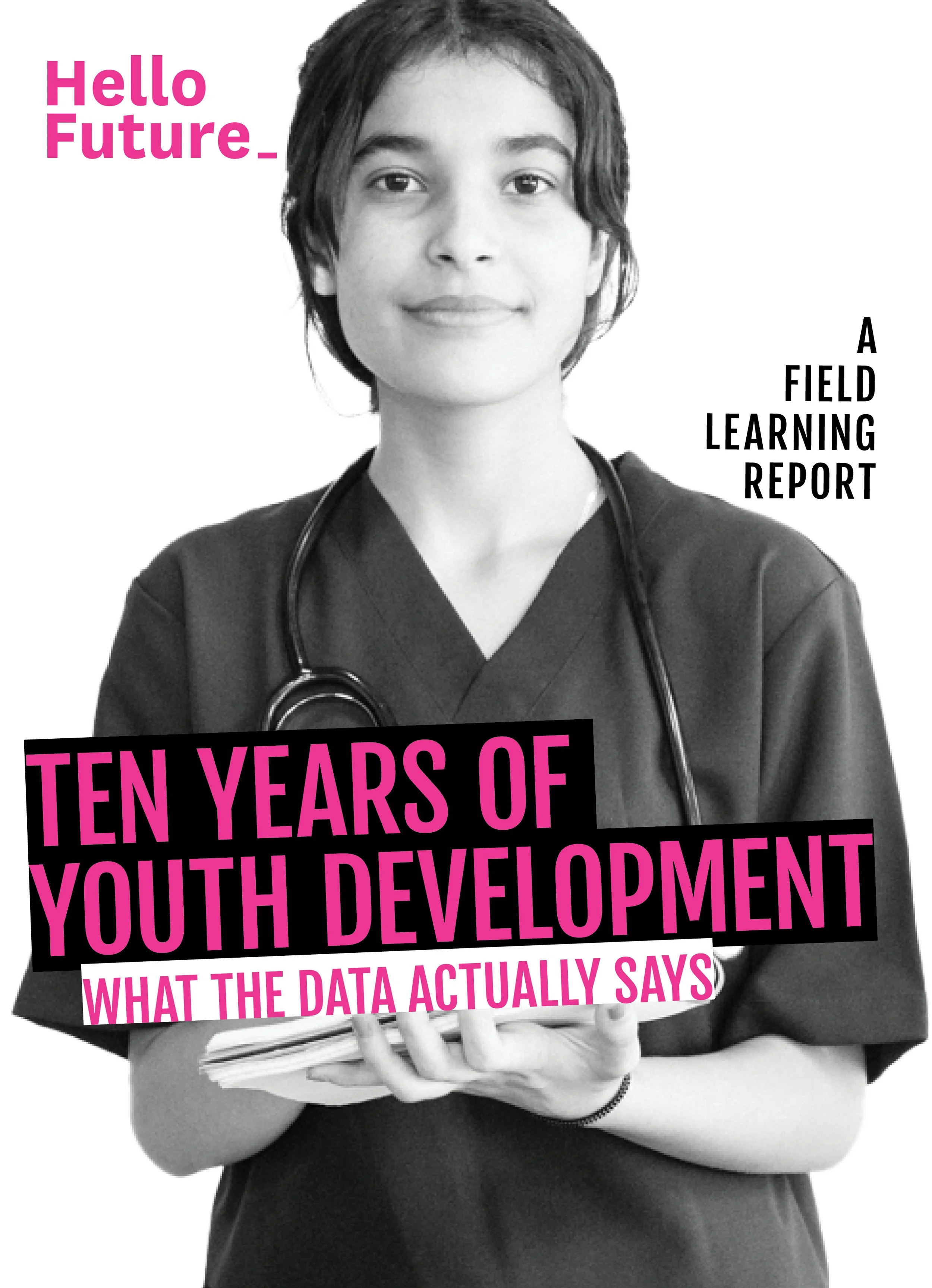
We have a decade of evidence that this is possible. The methodology, the five core findings, the limitations of the existing data, and what the evidence makes possible next are available in a new companion document: Ten Years of Youth Development: A Field Learning Report.
The report is the evidence. This is the argument.